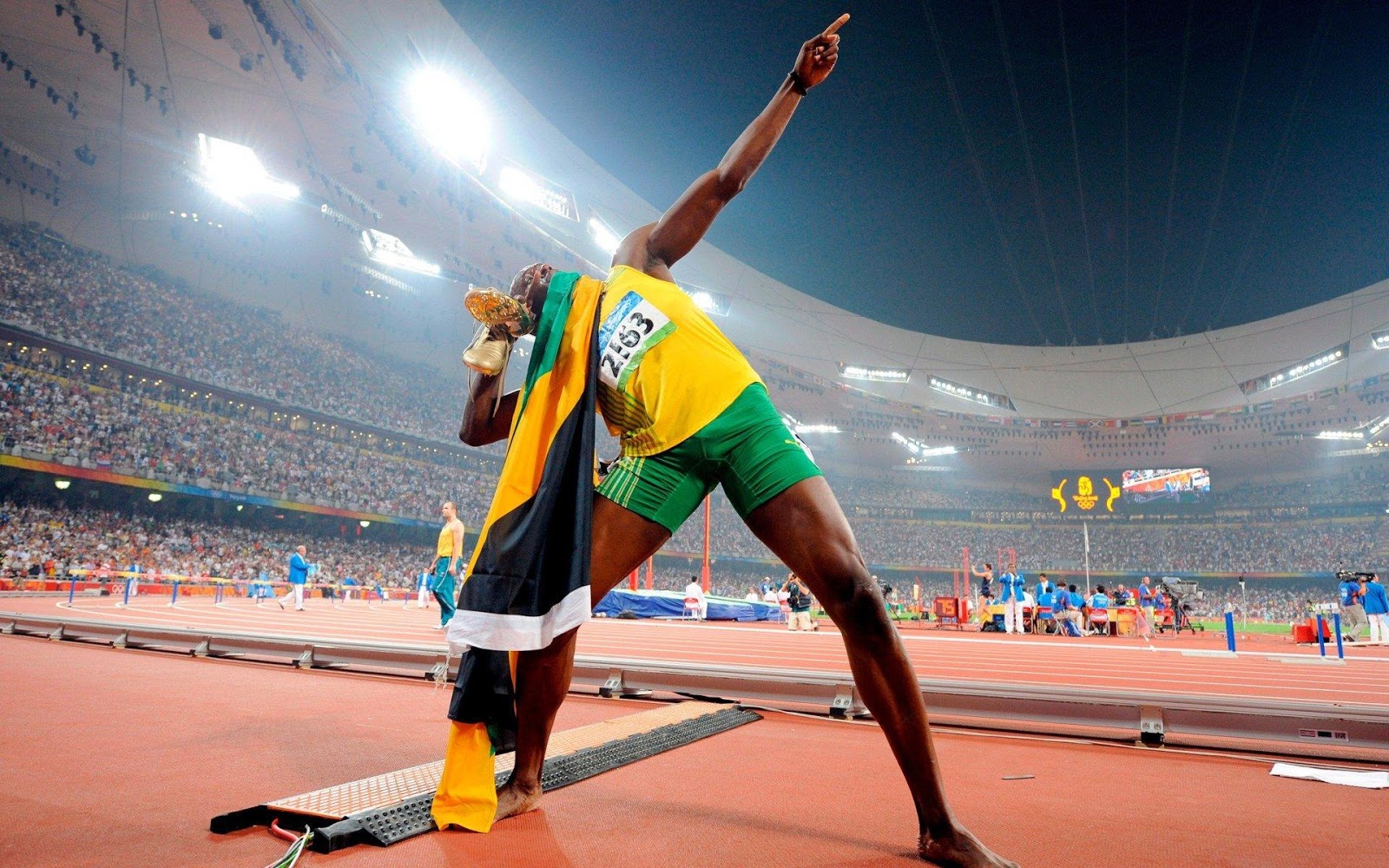
Usain St. Leo Bolt, OJ, CD ( born 21 August 1986) is a Jamaican sprinter. Regarded as the fastest person ever, he is the first man to hold both the 100 metres and 200 metres world records since fully automatic time measurements became mandatory in 1977. Along with his teammates, he also set the world record in the 4×100 metres relay. He is the reigning Olympic champion in these three events, the first man to win six Olympic gold medals in sprinting, and an eleven-time World champion. He was the first to achieve a "double double" by winning 100 m and 200 m titles at consecutive Olympics (2008 and 2012), and topped this through the first "double triple" (including 4×100 m relays).
Although gaining worldwide popularity for a sprint double victory at the Beijing Games, Bolt has had more victories as a 200 m runner. While he had not won any significant 100 m title prior to the 2008 Olympics, he had won numerous crowns in the 200 m event at the youth, junior and senior levels. Further, at the 2013 World Championships in Moscow, Bolt completed a hat-trick of 200 m world titles by winning his third straight gold in the event. His 2009 record breaking margin for 100 m, from 9.69 seconds (his own previous world record) to 9.58, is the highest since the start of fully automatic time measurements.

Bolt's achievements in sprinting have earned him the media nickname "Lightning Bolt",and awards including the IAAF World Athlete of the Year, Track & Field Athlete of the Year, and Laureus World Sportsman of the Year (three times). He is the highest paid athlete ever in track and field. He has been called the world's most marketable athlete. By winning three gold medals at the 2015 World Championships, Bolt became the first athlete to complete a "triple triple", and also became the most successful athlete in the 32-year history of the athletics world championships.
On 14 February 2015, Bolt announced that he intends to retire from athletics after the 2017 World Championships in London.
Bolt was born on 21 August 1986 in Sherwood Content, a small town in Trelawny, Jamaica, and grew up with his parents, Wellesley and Jennifer Bolt, his brother Sadiki,and his sister Sherine. His parents ran the local grocery store in the rural area, and Bolt spent his time playing cricket and football in the street with his brother,later saying, "When I was young, I didn't really think about anything other than sports".
As a child, Bolt attended Waldensia Primary, where he first began to show his sprinting potential, running in the annual national primary-schools' meeting for his parish. By the age of twelve, Bolt had become the school's fastest runner over the 100 metres distance.
Upon his entry to William Knibb Memorial High School, Bolt continued to focus on other sports, but his cricket coach noticed Bolt's speed on the pitch and urged him to try track and field events.Pablo McNeil, a former Olympic sprint athlete, and Dwayne Jarrett coached Bolt, encouraging him to focus his energy on improving his athletic abilities. The school had a history of success in athletics with past students, including sprinter Michael Green. Bolt won his first annual high school championships medal in 2001, taking the silver medal in the 200 metres with a time of 22.04 seconds. McNeil soon became his primary coach, and the two enjoyed a positive partnership, although McNeil was occasionally frustrated by Bolt's lack of dedication to his training and his penchant for practical jokes.
In his personal life, Bolt expresses a love for dancing and his character is frequently described as laid-back and relaxed. His Jamaican track and field idols include Herb McKenley and former Jamaican 100m and 200m world record holder, Don Quarrie. Michael Johnson, the former 200 m world and Olympic record holder, is also held in high esteem by Bolt.
According to the Catholic News Agency, Bolt is Catholic and known for making the sign of the cross before racing competitively, and he wears a Miraculous Medal during his races. His middle name is St. Leo.
In 2010, Bolt also revealed his fondness of music, when he played a reggae DJ set to a crowd in Paris.
The first sport to interest Bolt was cricket and he said if he was not a sprinter he would be a fast bowler instead. As a child he was a supporter of the Pakistani cricket team and admired the bowling of Waqar Younis. He is also a fan of Indian batsman Sachin Tendulkar, West Indian opener Chris Gayle[192] and Australian opener Matthew Hayden. During a charity cricket match Bolt clean-bowled Chris Gayle. Gayle was complimentary of Bolt's pace and swing.[194] Bolt also struck a six off Chris Gayle's bowling. Another bowler complimentary of Bolt's pace was former West Indies fast-bowling great Curtly Ambrose.
The Australian cricketer Shane Warne said in 2012 that Bolt would be interested in playing in the cricket Big Bash League, this was later confirmed by Bolt who said that "[Shane Warne] contacted me and asked me about if I am serious and if I really want to do it then he can put in a few words that should get it done. So we will see if I get the time off. I will try." He also said he likes the Twenty20 version of the game: "Just the fact that it is so exciting, it's about going hard the whole time, not just about playing shots. It's about being aggressive and I like that style of batsman. If I get the chance I will definitely try because I know it's going to be a lot of fun. I don't know how good I am. I will probably have to get a lot of practice in." In response to Bolt's interest, Melbourne Stars chief executive Clint Cooper said: "We're going to wait until the Olympics is over and re-engage with him and his management company. We've got a couple of spots left on our list."
Bolt is also a fan of Premier League football team Manchester United. He has declared he is a fan of Dutch striker Ruud van Nistelrooy. Bolt was a special guest of Manchester United at the 2011 UEFA Champions League Final in London, where he stated that he would like to play for them after his retirement.
In 2013, Bolt played basketball in the NBA All-Star Weekend Celebrity Game. He scored two points from a slam dunk but acknowledged his other basketball skills were lacking.
AWARDS
IAAF World Athlete of the Year: 2008, 2009, 2011, 2012, 2013
Track & Field Athlete of the Year: 2008, 2009
Laureus World Sportsman of the Year: 2009, 2010, 2013
BBC Overseas Sports Personality of the Year: 2008, 2009, 2012
L'Équipe Champion of Champions: 2008, 2009, 2012
Jamaica Sportsman of the year: 2008, 2009, 2011, 2012, 2013
Marca Leyenda (2009)
In October 2008, he was made a Commander of the Order of Distinction,which entitles him to use the post nominal letters CD.
In 2009, at age 23, Usain Bolt became the youngest member so far, of the Order of Jamaica. The award was 'for outstanding performance in the field of athletics at the international level'. In the Jamaican honours system, this is considered the equivalent of a knighthood in the British honours system, and entitles him to be formally styled "The Honourable", and to use the post nominal letters OJ.

Bolt's personal best of 9.58 seconds in the 100 metres is the fastest ever run.Bolt also holds the second fastest time of 9.63 seconds, the current Olympic record, and set two previous world records in the event. Bolt's personal best of 19.19 s in the 200 metres is the world record. This was recorded at the 2009 World Championships in Athletics in Berlin against a headwind of −0.3 m/s. This performance broke his previous world record in the event, his 19.30 s clocking in winning the 2008 Olympic 200 metres title.

Bolt has been on three world-record-setting Jamaican relay teams. The first record, 37.10 seconds, was set in winning gold at the 2008 Summer Olympics. The second record came at the 2011 World Championships in Athletics, a time of 37.04 seconds. The third world record was set at the 2012 Summer Olympics, a time of 36.84 seconds.

Bolt also holds the 200 metres world teenage best results for the age categories 15 (20.58 s), 16 (20.13 s, world youth record), 17 (19.93 s) and 18 (19.93 s, world junior record).He also holds the 150 metres world best set in 2009, during which he ran the last 100 metres in 8.70 seconds, the quickest timed 100 metres ever.


